Recently, the research group of Xuan Weimin from the College of Chemistry and Chemical Engineering has made an important breakthrough in the higher-order assembly and proton conduction of giant polyoxometalates. The related research findings, titled "Dimensional Evolution from a Giant Molybdenum-Red Cage-like {Mo200} to 1D Chains Enabling Ultrahigh Proton Conduction," were published in the Journal of the American Chemical Society (JACS).
Giant cage-like polyoxometalates (POMs) with confined cavities and open windows not only provide abundant metal and oxygen sites but also serve as excellent ion transport containers, showing great potential in energy conversion fields such as proton conduction. However, how to use these enormous hollow cage-like clusters as building blocks to overcome steric hindrance and assemble them into high-dimensional, long-range ordered continuous networks has long been a highly challenging problem in polyoxometalate assembly chemistry. Meanwhile, increasing dimensionality helps enhance the continuity of proton transport channels, thereby opening a feasible pathway for developing superprotonic conducting materials.
To address the above synthetic challenge, the team of Distinguished Research Fellow Xuan Weimin successfully synthesized an unprecedented 204-nuclear hollow nanocage compound 1, {Mo8}0.5@{Mo200}, and its one-dimensional chain-like derivative compound 2, [{Mo8}0.5@{Mo198}{Mo8}]n, by introducing phenylphosphonic acid as a structure-directing agent. In the assembly of compound 1, the organophosphonic acid ligands induce the generation of novel V-shaped {Mo5L} and {Mo5L}* building units. Due to the inequivalence of these two units and the synergistic effect of the {Mo8} guest template inside the cavity, the symmetry of the entire giant framework is broken from the ideal pseudo-D5d to C2h, forming a "drum-like" molecular cage that deviates from conventional fullerene topology. This structure possesses a huge internal cavity of approximately 2.2 nm × 1.5 nm and belongs to the extremely rare "molybdenum-red" family.
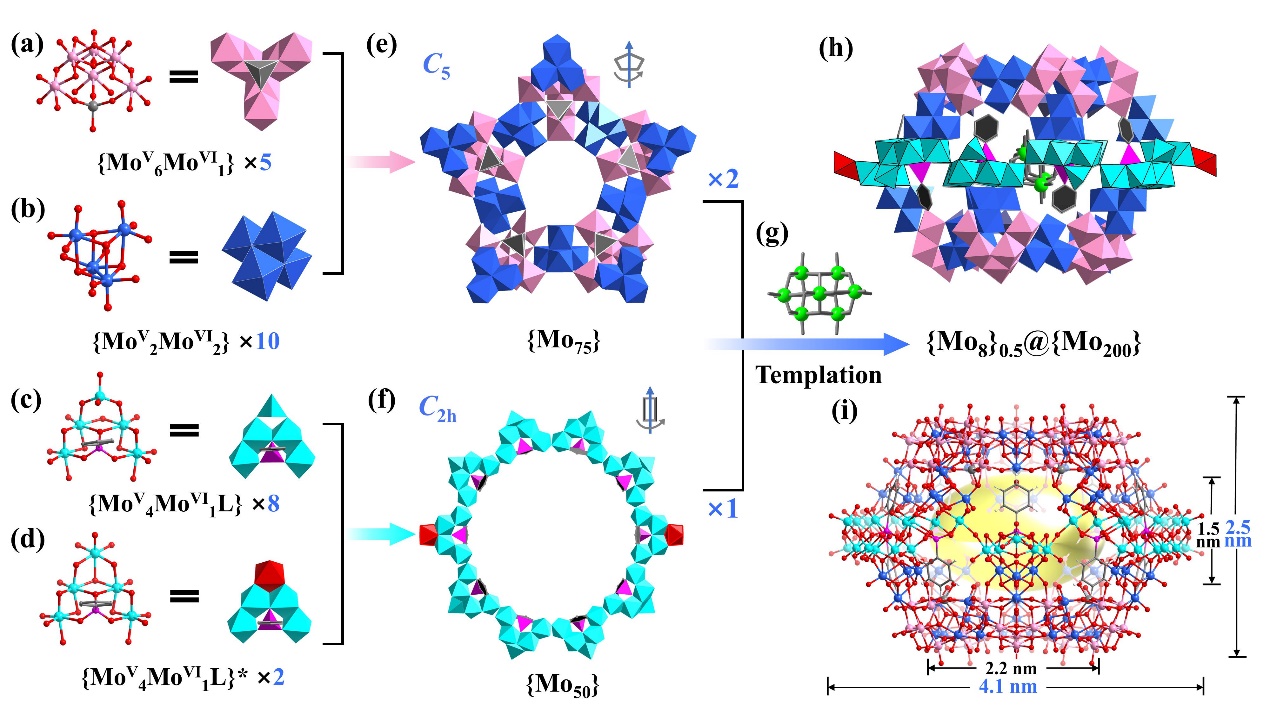
Figure 1. Structure of the giant cage-like molybdenum-red cluster {Mo8}0.5@{Mo200}
By modulating the synthetic conditions, the two sets of {Mo5L}* units in the equatorial region of compound 1 undergo adaptive coordination adjustments, removing two {Mo1} tail units and converting the {Mo200} cage-like framework into a {Mo198} intermediate with open connection sites. Subsequently, the {Mo8} cluster acts as a two-connected inorganic ligand and undergoes precise directional assembly with the {Mo198} nodes, thereby driving the structural transition from a 0D discrete cage to a 1D chain-like structure. This work is the first to use giant clusters as nodes and construct multidimensional frameworks through a "cluster-connecting-cluster" strategy, breaking through the limitations of conventional cluster dimensional evolution and providing a new paradigm for the design of higher-order topological structures.
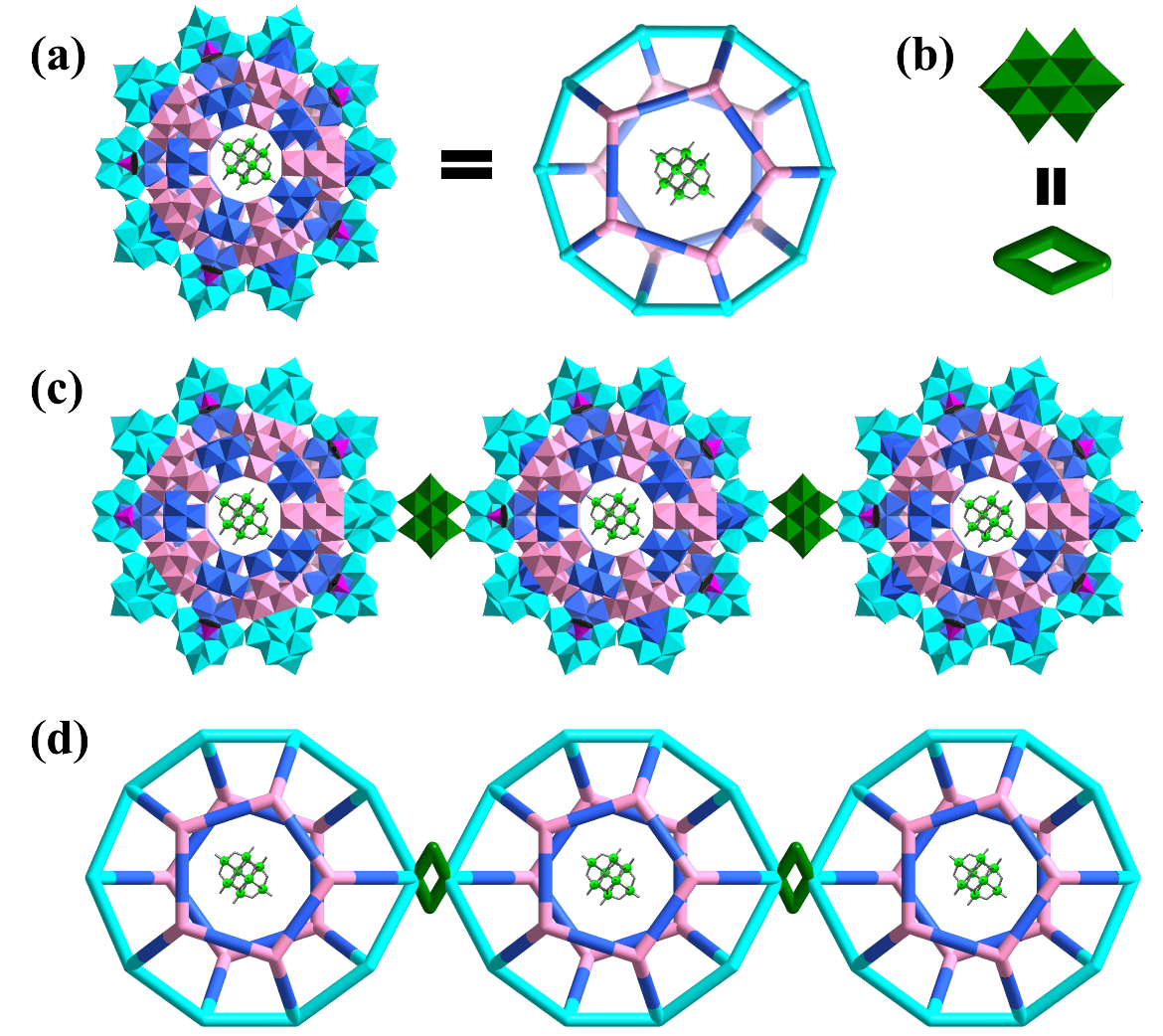
Figure 2. Structure of the one-dimensional chain [{Mo8}0.5@{Mo198}{Mo8}]n
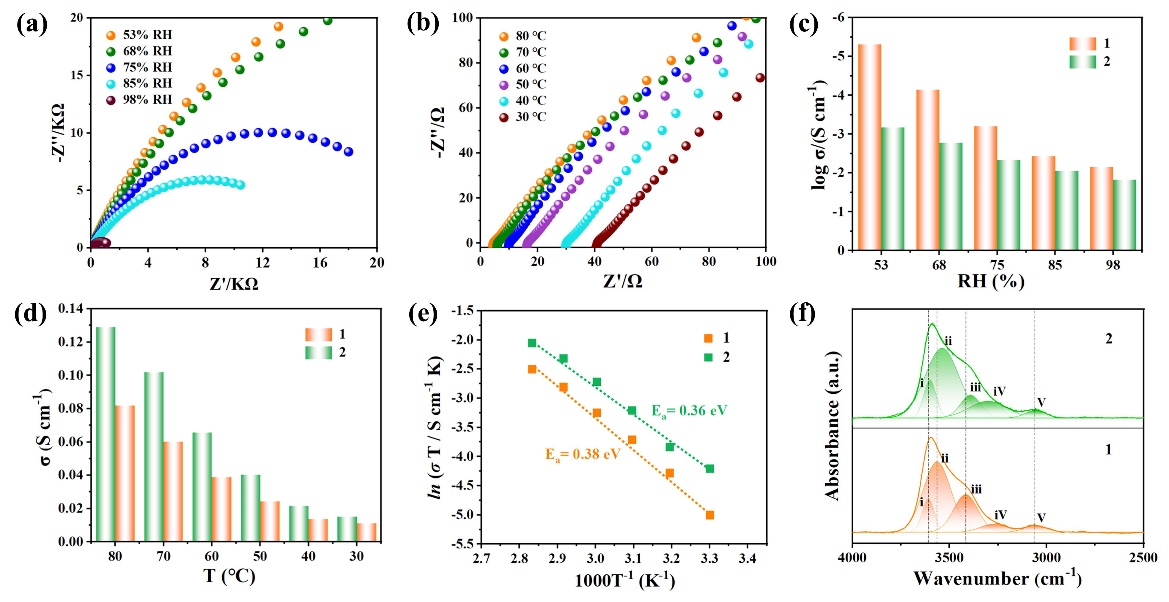
Figure 3. Proton conductivity, activation energy, and in situ infrared spectra of compounds 1 and 2
Benefiting from abundant surface oxygen sites, a large internal confined cavity, and open windows at both the top and bottom ends, the above structures seamlessly connect the water molecules enriched internally with the external environment, spontaneously forming a multi-scale hydrogen-bonded network of hydrated protons that penetrates both inside and outside. AC impedance test results show that at 80 °C and 98% relative humidity, the discrete cage-like compound 1 exhibits a proton conductivity as high as 8.28 × 10⁻² S cm⁻¹. In contrast, in the one-dimensional continuous chain-like structure, a large number of extended Mo–O–Mo bridging bonds effectively stitch together the physical gaps between clusters, thereby significantly lowering the proton hopping energy barrier, causing the proton conductivity of compound 2 to surge dramatically to 1.28 × 10⁻¹ S cm⁻¹, an approximately 1.5-fold improvement over compound 1. This performance ranks among the best POM-based solid-state proton conductors. This work not only greatly enriches the structural library of giant molybdenum-red clusters, but also lays a solid theoretical and experimental foundation for the rational design and development of high-performance solid-state proton conductor materials and next-generation clean energy conversion devices.
This research was supported by the National Natural Science Foundation of China and other projects. Duidui Zhang, a 2024 master's graduate of Donghua University (currently pursuing a doctoral degree at Tsinghua University), and doctoral student Rongqing Tang are the co-first authors of the paper. Distinguished Research Fellow Weimin Xuan of Donghua University, Professor Yongge Wei of Tsinghua University, Professor Leroy Cronin and Professor DeLiang Long from the University of Glasgow, UK, are the co-corresponding authors. Donghua University is the first corresponding institution.
Original link to this article: https://pubs.acs.org/doi/10.1021/jacs.6c06499