I wonder if electric vehicle owners experience this kind of agony: on a scorching summer day, sunlight (including visible and near-infrared rays) pours through the panoramic glass roof, subjecting the car interior to an intense "baking" test. After being roasted under the blazing sun, the cabin turns into a mobile "sauna" or "oven," with temperatures exceeding 60°C, and the steering wheel becomes too hot to hold.
The same distress also plagues office workers seated by the windows of high-rise buildings: the afternoon sun relentlessly delivers heat to their workstations, raising the ambient temperature and rendering the air conditioning seemingly ineffective. The indoor temperature can barely be maintained at 26–27°C, comfort levels plummet, and computer screens must be turned to maximum brightness to remain visible, which compromises both work efficiency and physical and mental well-being.
Against the backdrop of the current global energy transition and rapid technological advancement, these phenomena have drawn sustained societal attention to novel glass windows and doors capable of light and thermal management. Smart electrochromic glass, which offers efficient spectral modulation and can autonomously switch between transparent and tinted states to effectively block visible light and near-infrared heat, has become a key direction in promoting green buildings and low-carbon transportation systems. However, developing low-cost, highly stable, large-area electrochromic glass that can modulate the entire solar spectrum remains a critical challenge in the field.
Recently, a team led by Professor Wang Hongzhi and Researcher Li Kerui from the College of Materials Science and Engineering and the State Key Laboratory for Modification of Chemical Fibers and Polymer Materials at Donghua University proposed a new electrochromic strategy based on dynamic assembly-enhanced plasmonic resonance (DarpE). They constructed a suspended dispersion structure using nanoclusters as unique functional motifs. By controlling the suspension–aggregation behavior of the polyoxometalate clusters, they achieved efficient modulation of the entire solar spectrum. The team developed a cluster-containing electrochromic hybrid gel, pioneering the study of spatial dynamic behavior in optoionic gel systems, and fabricated low-cost, long-lifespan, large-area all-in-one electrochromic devices, overcoming the complexity and cumbersome nature of traditional multilayer fabrication processes. The resulting electrochromic device exhibits a solar spectral modulation range of up to 86.4 %, with an average transmittance as low as 1.4 % in the colored state (Fig. 1). The relevant findings were published in Nature Sustainability under the title “Scalable all-in-one electrochromic glazing for full-spectrum solar radiation management”.
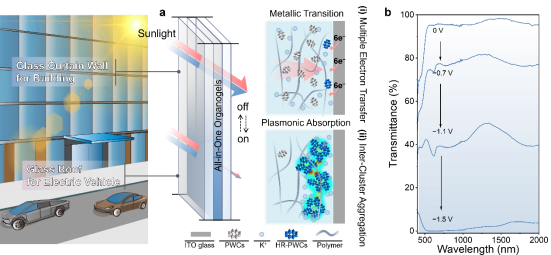
Figure 1 Full-spectrum solar radiation electrochromic smart window based on dynamic assembly-enhanced plasmonic resonance (DarpE)
Upon application of a voltage, the polyoxometalate clusters migrate to the electrode interface, driving more electrons to be injected into the clusters and facilitating multi-electron transfer, thereby completing the transition from an insulating state to a semiconducting–metallic state. The highly reduced clusters spontaneously aggregate within the electrochromic hybrid gel, undergoing dynamic spatial redistribution. The plasmonic coupling between the aggregated clusters enhances near-infrared absorption, endowing the device with excellent solar spectral modulation capability (Fig. 2).
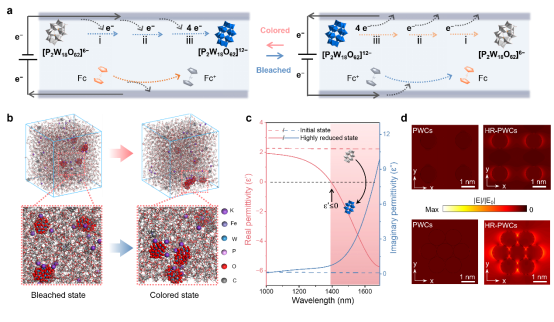
Figure 2 Synergistic enhancement of plasmonic resonance absorption of near-infrared light by multi-electron transfer and aggregation behavior of the clusters
By introducing a polymer framework structure into the gel, the polar groups and steric hindrance effects of the polymer suppress the formation of large-sized aggregates, effectively regulate the suspension–aggregation behavior of the clusters, and achieve a stable and reversible dynamic process, ensuring excellent cycling stability of the device. After 50,000 cycles, it retains 90.3% of its optical stability. Even for large-area electrochromic devices of ≥900 cm², outstanding optical modulation and stability are maintained (Fig. 3).
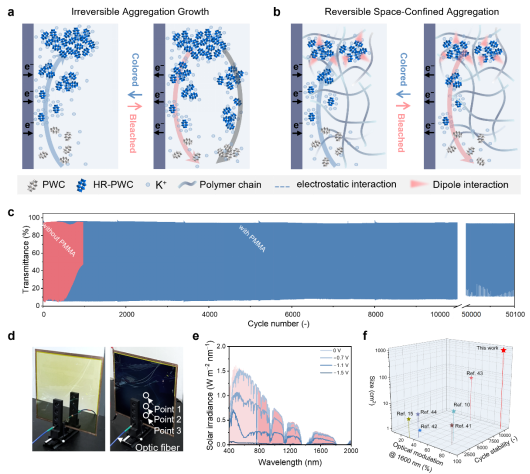
Figure 3 Reversible aggregation behavior enabled by a polar polymer framework and large-area fabrication of highly stable electrochromic glass
The energy of sunlight is mainly concentrated in the visible and near-infrared bands. Benefiting from the excellent broadband spectral modulation capability and stability of the DarpE device, it can block solar radiation and achieve efficient thermal insulation. As an ideal thermal barrier, the DarpE device can be widely applied in smart windows for buildings and dimming panoramic roofs for vehicles. It not only blocks dazzling sunlight from entering the interior of a building or vehicle but also effectively reduces the indoor temperature and enhances human comfort. At the same time, the device helps lower the energy consumption of cooling equipment such as air conditioners, promoting energy saving and emission reduction in the construction and automotive sectors, and actively contributing to China’s "dual carbon" strategy (Fig. 4).
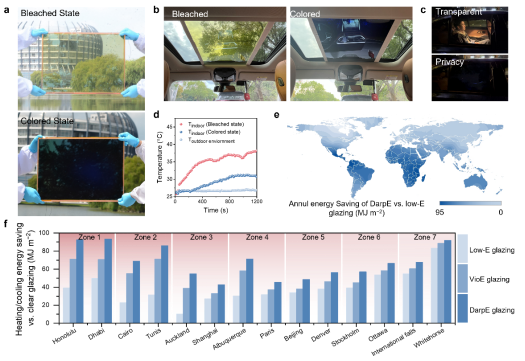
Figure 4 Large-area electrochromic glass for sustainable buildings and vehicles
Furthermore, using the aggregation-enhanced near-infrared modulation strategy, the research team developed functional motifs based on heteroaromatic tripyridine (H-TriPy) molecules. Through electric-field-driven interfacial aggregation, they induced conjugated stacking of the functional motifs, significantly enhancing near-infrared absorption and achieving dual-band modulation of visible and near-infrared light. This enabled the device to reach a near-zero transmittance state (1.6%) in the colored state, and it retained 89.1% of its performance stability after 100,000 cycles. The related paper, titled “Heteroaromatic π-stacking engineered near-infrared absorption for highly stable near-zero transmittance electrochromic window,” was published in Nature Communications (Nat. Commun. 2025, 16, 9964).
Original link to this article:https://www.nature.com/articles/s41893-026-01823-w