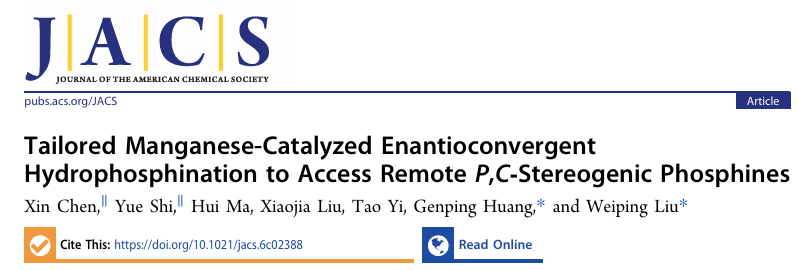
Recently, the research group of Professor Liu Weiping from the Intelligent Health Management Team led by Professor Yi Tao at the College of Chemistry and Chemical Engineering has achieved new progress in the field of manganese-catalyzed asymmetric borrowing hydrogen reactions. This work, titled "Tailored Manganese-Catalyzed Enantioconvergent Hydrophosphination to Access Remote P,C-Stereogenic Phosphines," has been published in the Journal of the American Chemical Society, a internationally renowned journal in the field.
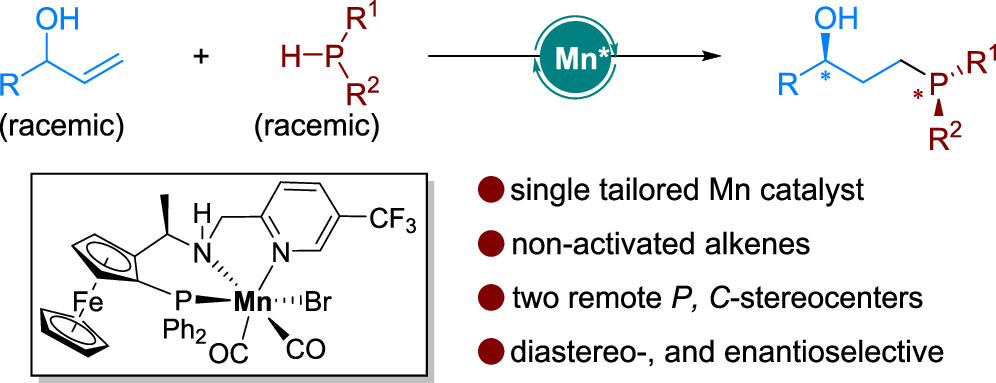
Chiral phosphine compounds containing both phosphorus and carbon stereocenters are widely used as organocatalysts or transition-metal ligands in organic synthesis. Transition metal-catalyzed asymmetric hydrophosphination of alkenes provides a direct and atom-economical route for the synthesis of chiral phosphine compounds. However, this strategy is generally limited to electron-deficient alkenes and mainly generates a single C- or P-stereocenter. Therefore, the construction of phosphine compounds bearing remote P and C stereocenters via asymmetric hydrophosphination remains challenging. Conventional methods typically rely on stepwise construction of stereocenters, involving multiple synthetic steps and low overall efficiency. The borrowing hydrogen strategy, through a dehydrogenation-transformation-hydrogenation cascade, reduces the need for intermediate isolation and avoids the use of external oxidants and reductants, and has become an important platform for achieving atom- and step-economical synthesis.
The research group of Professor Liu Weiping has been dedicated to the study of high-yield metal-catalyzed borrowing hydrogen reactions. In previous work, the group has developed a series of high-yield metal-catalyzed borrowing hydrogen reactions, achieving atom-economical and redox-neutral valorization of simple alcohols (J. Am. Chem. Soc., 2025, 147, 21209-21218; Nat. Commun., 2024, 15, 6798; J. Am. Chem. Soc., 2023, 145, 47, 25545-25552; Angew. Chem. Int. Ed. 2023, 62, e202215882; Angew. Chem. Int. Ed. 2023, 62, e202303433). Recently, by employing an asymmetric borrowing hydrogen strategy, the group achieved manganese-catalyzed enantioconvergent hydrophosphination of racemic allylic alcohols using a borrowing hydrogen approach. By utilizing a single catalyst to simultaneously control two remote and flexible P- and C-stereocenters, they realized the efficient synthesis of chiral γ-hydroxyphosphine compounds. Furthermore, the practicality of this catalytic system is demonstrated by its scalability, diverse derivatization reactions, and the successful application of its derivatives as chiral bidentate ligands in asymmetric hydrogenation reactions.
Xin Chen, a Ph.D. student of the Class of 2022 from the College of Chemistry and Chemical Engineering at Donghua University, and Yue Shi from Tianjin University are the co-first authors of this paper. Professor Liu Weiping from Donghua University and Professor Huang Genping from Tianjin University are the co-corresponding authors. Donghua University is the primary affiliation of the correspondence. This work was supported by the National Natural Science Foundation of China and the Fundamental Research Funds for the Frontiers Interdisciplinary Innovation Team Development Program (Lizhi Program) of Donghua University.
Original link to this article:https://pubs.acs.org/doi/10.1021/jacs.6c02388