Mesoporous powders, when subjected to a certain temperature (or temperature and pressure), can preferentially collapse from “weak bridges” (the weak connecting sites of the skeleton) into highly surface-active nanofragments, which promote particle aggregation and fusion, thereby helping to lower the sintering temperature of the material. This effectively protects functional units that are prone to deactivation at high temperatures and enables the low-temperature preparation of structurally and functionally integrated ceramics, which is a significant achievement. Among these, how to evenly disperse functional units into the pores or walls of mesoporous powders is a prerequisite for designing and constructing high-performance structurally and functionally integrated ceramics.
To address these requirements, a research team led by Wei Luo and Pengpeng Qiu from the State Key Laboratory of Advanced Fiber Materials and the College of Materials Science and Engineering at Donghua University has recently developed a highly general and controllable “ligand-assisted interfacial monomicelle assembly coupled with NH₃ carbonization” strategy. This approach successfully achieves the in-situ assembly of intermetallic nanoparticles (iNPs) within mesoporous carbon (mC) carriers. The relevant findings, titled “Ligand-assisted interfacial monomicelle assembly to incorporate intermetallic nanoparticles into mesoporous carbon nanostructures,” have been published in Nature Protocols. This method utilizes metal-dopamine-block copolymer composite monomicelles as building units. Through a one-step thermal treatment, it simultaneously achieves the ordering of metal atoms, the mesopore formation of the carbon skeleton, and the in-situ anchoring of iNPs within the mesopore walls. This effectively resolves issues commonly encountered in traditional methods, such as the tendency of iNPs to aggregate, uneven size distribution, and weak interactions with the carrier. This strategy achieves precise control over the iNPs composition (from binary to octonary), atomic ordering degree (0–95%), and crystalline phases (e.g., L1₀, L1₂), and it can be adapted to carbon carriers with various morphologies, including zero-dimensional, one-dimensional, and two-dimensional structures.
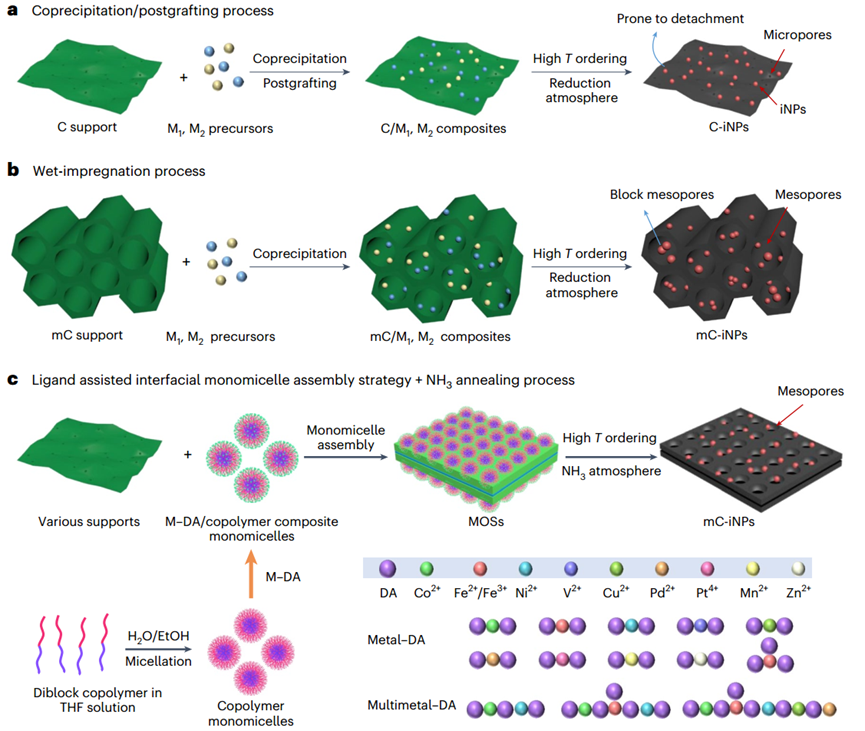
Figure 1 Schematic illustration of different synthetic methods for loading iNPs onto carbon supports. a. Coprecipitation/post-grafting process followed by high-temperature reduction treatment. b. Wet impregnation process: mesoporous carbon supports are first prepared, and then metal precursors are introduced into the mesopores via vacuum filtration or surface functionalization. c. Ligand-assisted interfacial monomicelle assembly strategy followed by NH₃ annealing treatment (using monomicelle assembly on two-dimensional carbon supports as an example). © 2026 Nature Protocols
Compared with conventional methods, the key distinction of this strategy lies in that coprecipitation and post-grafting tend to block the mesoporous channels, while wet impregnation easily leads to particle aggregation due to capillary forces. In contrast, this approach achieves in-situ anchoring of intermetallic nanoparticles (iNPs) into the mesopore walls through the construction of metal-organic superstructures coupled with NH₃ carbonization, thereby avoiding the above-mentioned issues.
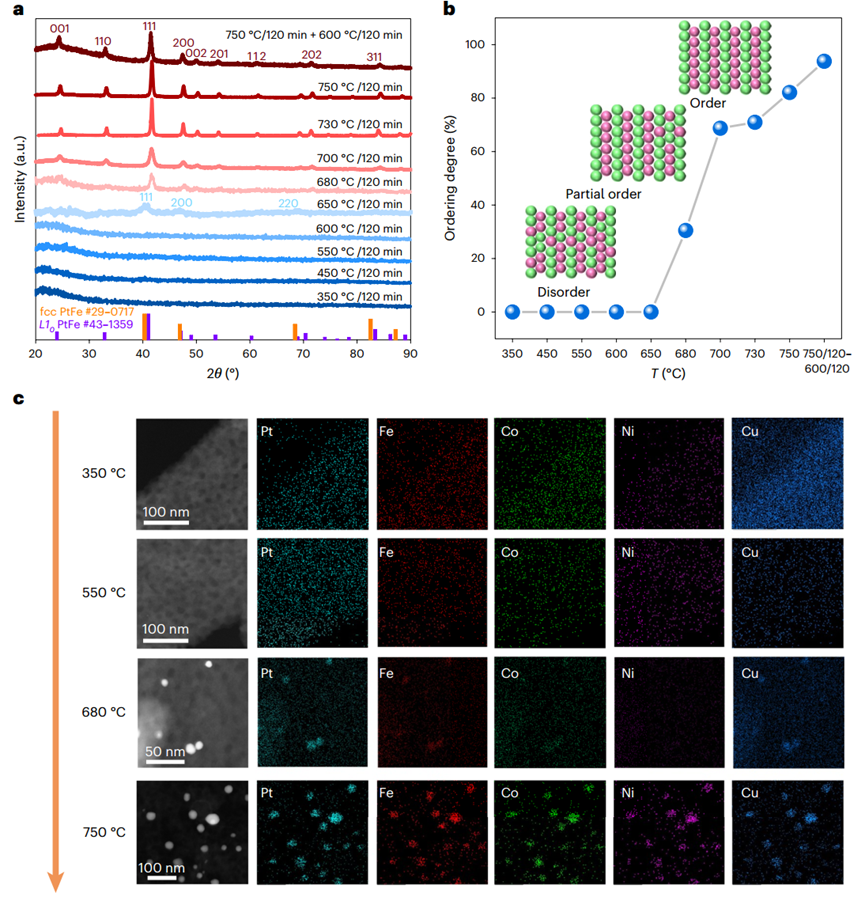
Figure 2 Characterization of PtFeCoNiCu iNPs-mC-GO under different annealing temperatures. a. XRD patterns. b. Calculated degree of ordering. c. Dark-field STEM image and corresponding elemental mapping images (scale bar, 50 nm). © 2026 Nature Protocols
Effect of annealing temperature on the degree of ordering of iNPs: XRD analysis shows that only amorphous metal clusters are present below 600 °C; a disordered face-centered cubic PtFe phase appears at 650 °C; characteristic diffraction peaks of the L1₀ ordered phase (24.2° and 33.4°) begin to emerge above 680 °C. As the temperature increases from 680 °C to 750 °C, the degree of ordering increases from 30.5% to 82.1%. When a two-step NH₃ annealing process (750 °C/120 min followed by 650 °C/120 min) is applied, the degree of ordering reaches 93.8%. Dark-field STEM and elemental mapping images confirm that all metal elements remain uniformly distributed even at high temperatures.
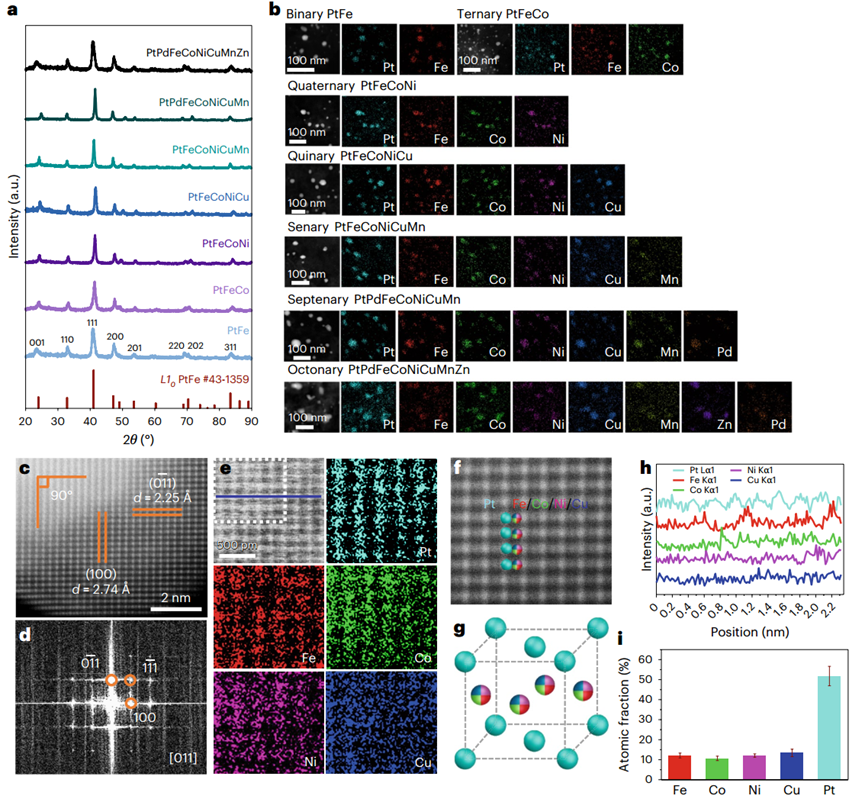
Figure 3 Characterization of Pt-based iNPs-mC-GO from binary to octonary systems. a. XRD patterns. b. Dark-field STEM images and corresponding elemental mapping images (scale bar, 50 nm). c-i. Characterization of the quinary PtFeCoNiCu iNPs-mC-GO sample: c. Atomic-resolution HAADF-STEM image (scale bar, 1 nm); d. Corresponding FFT pattern along the [011] zone axis; e. Atomic-resolution HAADF-STEM image and corresponding elemental mapping images (scale bar, 1 nm); f. Schematic illustration of elemental distribution at lattice sites overlaid on the HAADF image; g. Simulated atomic structure model; h. Column intensity profile along the red line in figure f; i. Atomic fractions of each element. © 2026 Nature Protocols
XRD analysis shows that from the binary PtFe to the octonary PtPdFeCoNiCuMn alloy systems, all exhibit characteristic diffraction peaks of the ordered L1₀ phase. Through atomic-resolution HAADF-STEM observation and elemental mapping analysis, we have, for the first time, directly confirmed in a quinary alloy that Pt atoms occupy the vertex positions while Fe/Co/Ni/Cu atoms occupy the face-centered positions in an ordered arrangement. This discovery provides the most direct structural evidence for the existence of intermetallic compounds.
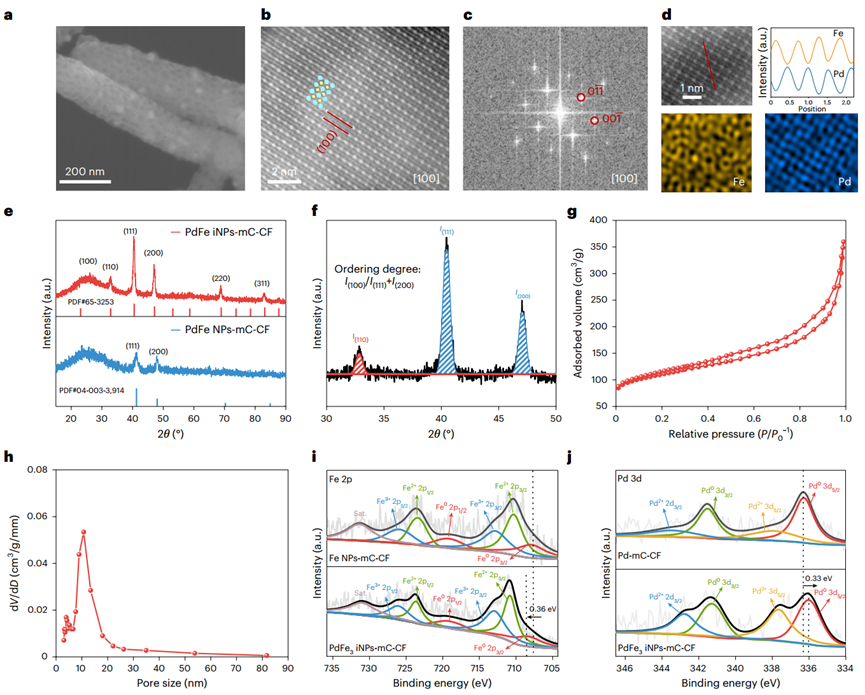
Figure 4 Detailed characterization of PdFe iNPs-mC-CF. a. SEM image (scale bar, 200 nm). b, c. Atomic-resolution HAADF-STEM images and corresponding FFT patterns along the [100] zone axis (scale bar, 2 nm). d. Magnified atomic-resolution HAADF-STEM image, column intensity profile along the red line, and corresponding atomic-scale EDS elemental mapping (scale bar, 1 nm). e. Comparative XRD patterns of ordered PdFe iNPs-mC-CF and disordered PdFe NPs-mC-CF. f. Quantitative evaluation of the peak areas of the (110) ordered peak and the (111) and (200) main peaks. g. N₂ adsorption-desorption isotherms. h. Pore size distribution analysis. i. High-resolution XPS spectra of the Pd 3d core level. j. High-resolution XPS spectra of the Fe 2p core level. © 2026 Nature Protocols
Taking the binary PdFe system as an example, multi-dimensional characterization of the product is comprehensively demonstrated: atomic-resolution HAADF-STEM confirms the alternating arrangement of Pd and Fe atoms in the L1₂ superlattice with a degree of ordering of 95%; the BET surface area is 400.10 m²/g, and the pore size is approximately 10 nm; XPS shows binding energy shifts of Pd and Fe, confirming the electronic interaction within the alloy.
This work provides a brand-new approach for the design and controllable preparation of high-quality functional ceramic powders as well as the low-temperature construction of structurally and functionally integrated ceramic materials, and is expected to promote the application of advanced ceramic materials under extreme environmental conditions.
Original link to this article:https://www.nature.com/articles/s41596-025-01326-6