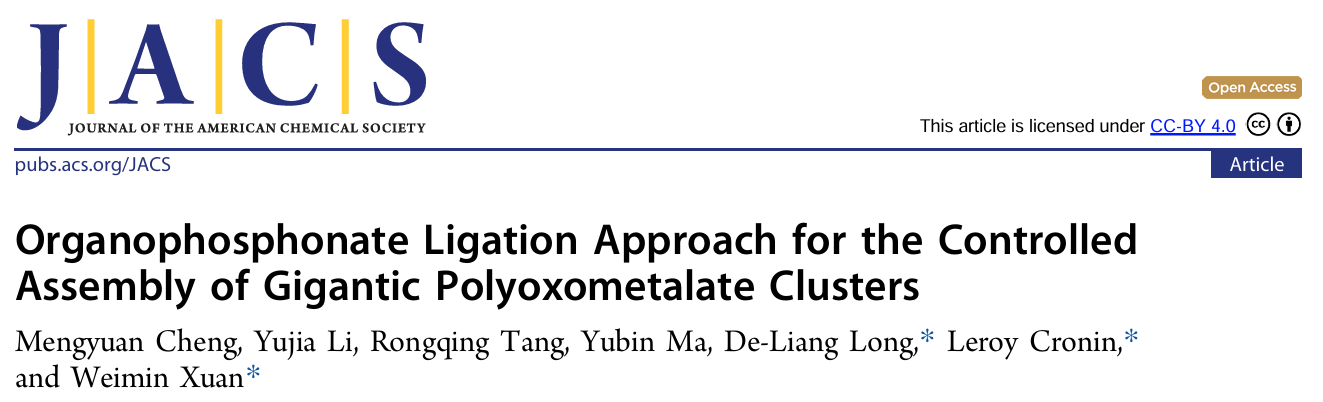
Recently, the research group of Distinguished Research Professor Xuan Weimin from the College of Chemistry and Chemical Engineering has achieved new progress in the controlled assembly of high-nuclear polyoxometalate clusters. The related findings, titled "Organophosphonate Ligation Approach for the Controlled Assembly of Gigantic Polyoxometalate Clusters," have been published in the Journal of the American Chemical Society (JACS), a top-tier international journal in the field of chemistry.
Polyoxometalates (POMs), as a class of discrete metal-oxo cluster compounds, possess rich structures and excellent physicochemical properties, holding broad application prospects in catalysis, sensing, materials science, biomedicine, and other fields. High-nuclear polyoxomolybdate (POMo) clusters, an important branch of POMs, consist of hundreds of molybdenum centers and can be classified into three types—molybdenum blue, molybdenum brown, and molybdenum red—based on the degree of reduction and structural building units. To date, a variety of novel structures have been successfully synthesized. However, because the self-assembly process of these gigantic molecules is highly dependent on extremely subtle synthetic parameters, how to precisely control the size, topology, and composition of the clusters through rational regulation of reaction conditions has remained a great challenge in the field of molecular self-assembly. To address this challenge, the research group of Xuan Weimin innovatively adopted an organophosphonate ligand-mediated strategy and successfully synthesized five novel high-nuclear molybdenum blue clusters: {Mo₁₃₆}, {Mo₁₂₀}, {Mo₁₁₈}, {Mo₁₁₈Na}, and {Mo₁₅₇}. Among them, {Mo₁₅₇} is the first example of a dodecameric molybdenum wheel assembly with a cluster@cluster host–guest structure. This study deeply reveals the regulatory mechanism of ligand competitive coordination and reaction conditions on the cluster structure, not only enriching the structural library of high-nuclear polyoxometalates but also establishing a new method for controlled assembly. The as-prepared clusters exhibit excellent solution stability and solubility in organic solvents, and can be functionalized with biomolecules, laying a solid foundation for their applications in catalysis, biosensing, and other fields.
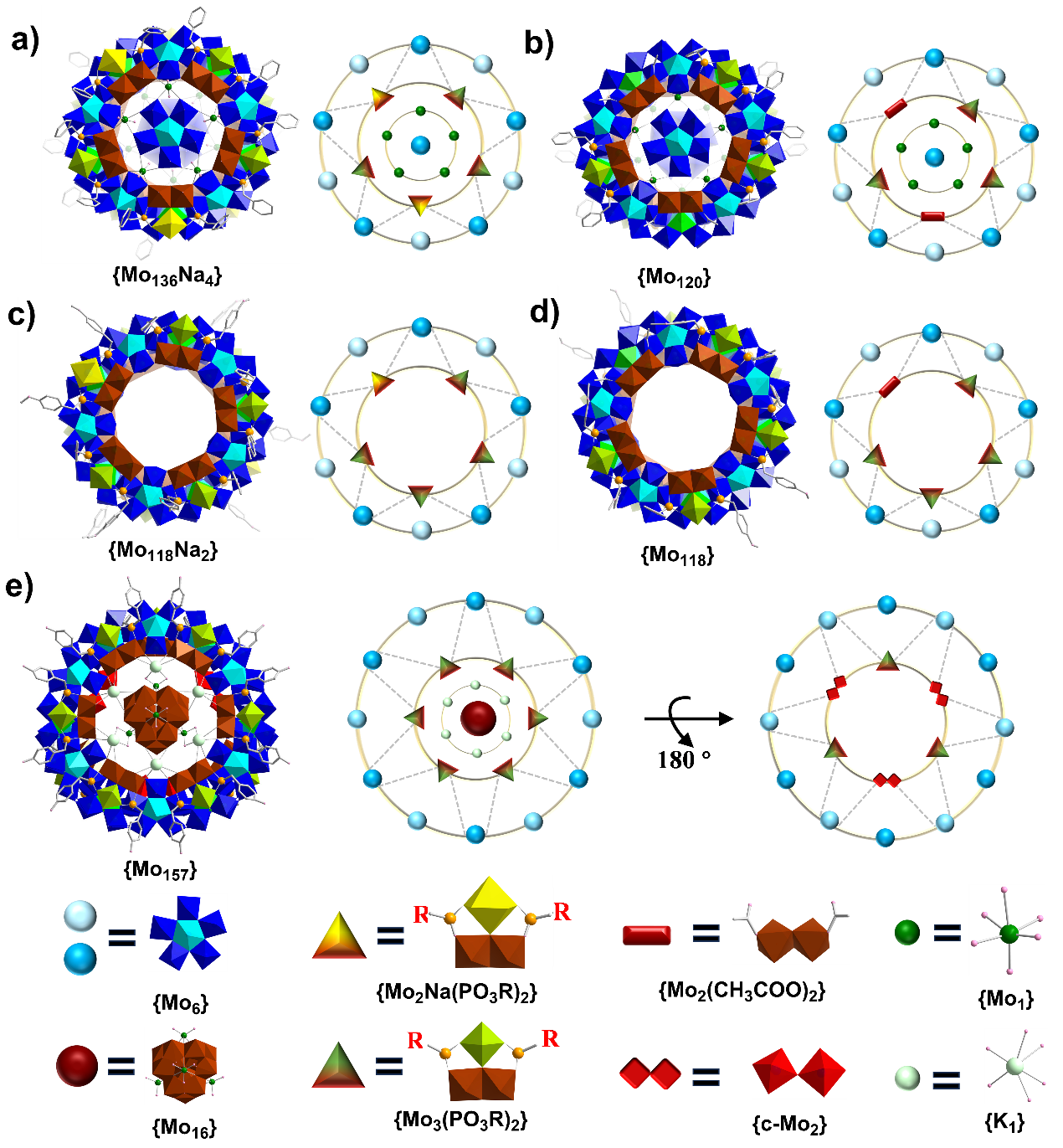
Figure 1 Structural evolution of wheel-shaped molybdenum blue clusters directed by organophosphonate ligands
The introduction of organophosphonate ligands not only enables precise synthesis of the structures but also significantly alters the physicochemical properties of the clusters. Research shows that compared to conventional inorganic molybdenum blue clusters, these novel organofunctionalized polyoxometalate clusters exhibit extremely high solubility in a variety of polar organic solvents (e.g., isopropanol, acetonitrile, DMF). This breakthrough not only overcomes the limitation that traditional molybdenum blue clusters are difficult to handle in organic phases but also opens up new avenues for post-synthetic modification of high-nuclear polyoxometalates. The research team further confirmed the structural integrity of these gigantic assemblies in solution using electrospray ionization mass spectrometry (ESI-MS) and nuclear magnetic resonance (³¹P NMR). By reacting {Mo₁₅₇} with nucleotide molecules such as guanosine monophosphate (GMP), it was confirmed that the coordinated water molecules on the outer surface of the clusters can be successfully substituted, thereby achieving precise post-synthetic modification of the peripheral microenvironment of molybdenum blue clusters. This provides an experimental basis and guidance for the future development of polyoxometalate-based biosensing platforms and the exploration of their interactions with biomacromolecules.
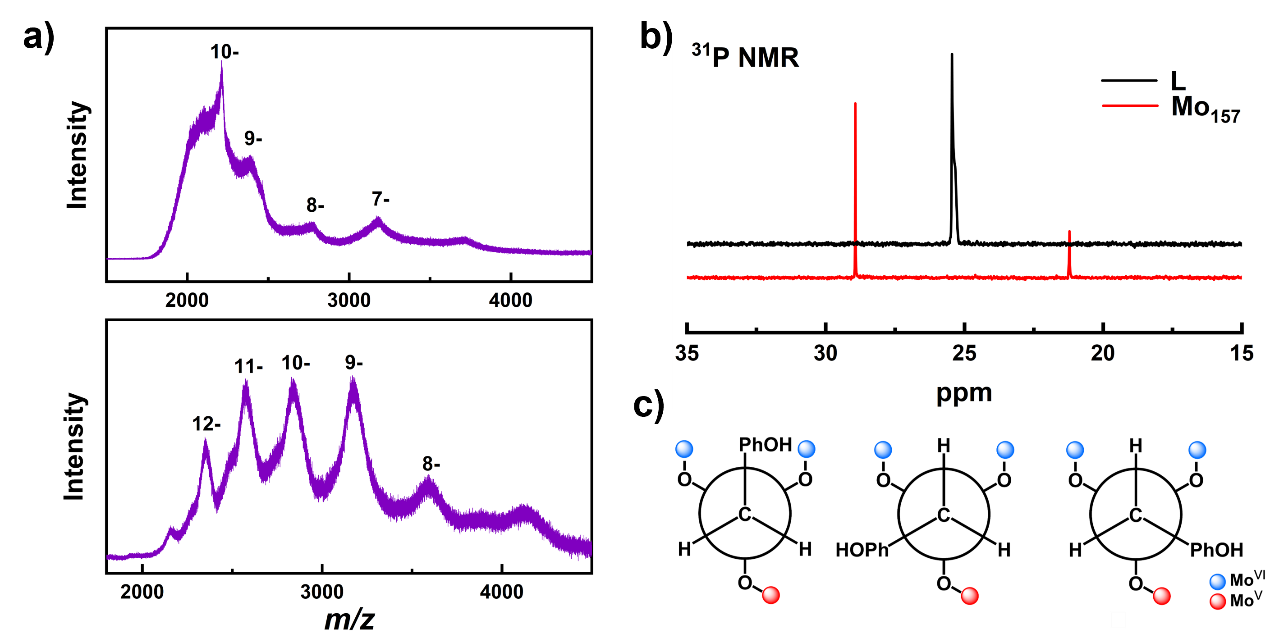
Figure 2 (a) ESI-MS spectra of {Mo₁₁₈} and {Mo₁₅₇} in CH₃CN solution; (b) ³¹P NMR of {Mo₁₅₇} with hydroxybenzylphosphonic acid in D₂O; and (c) schematic representation of three conformational isomers of the phenylphosphonic acid ligand
Mengyuan Cheng, a Ph.D. student from the College of Chemistry and Chemical Engineering, is the first author of this paper. Distinguished Research Professor Xuan Weimin from Donghua University, along with Professor Leroy Cronin and Professor Long Deliang from the University of Glasgow, are the co-corresponding authors. Donghua University is the primary affiliation of the correspondence. This work was supported by the National Natural Science Foundation of China, the Program for Professor of Special Appointment (Eastern Scholar) at Shanghai Institutions of Higher Learning, and the Fundamental Research Funds for the Interdisciplinary Frontier Innovation Team Development Program of Donghua University. The authors also thank the Testing Platform of the College of Materials Science and Engineering of Donghua University, and the Shanghai Synchrotron Radiation Facility for providing technical support for crystal data collection.
Original link to this article:https://doi.org/10.1021/jacs.5c21427