Recently, the research team led by Professor Cai Dongqing from the College of Environmental Science and Engineering has made significant progress in the field of rapid food waste fertilization, with the findings published in Nature Communications (2026). Associate Professor Zhu Yanping is the first author, and Donghua University is the primary corresponding institution.
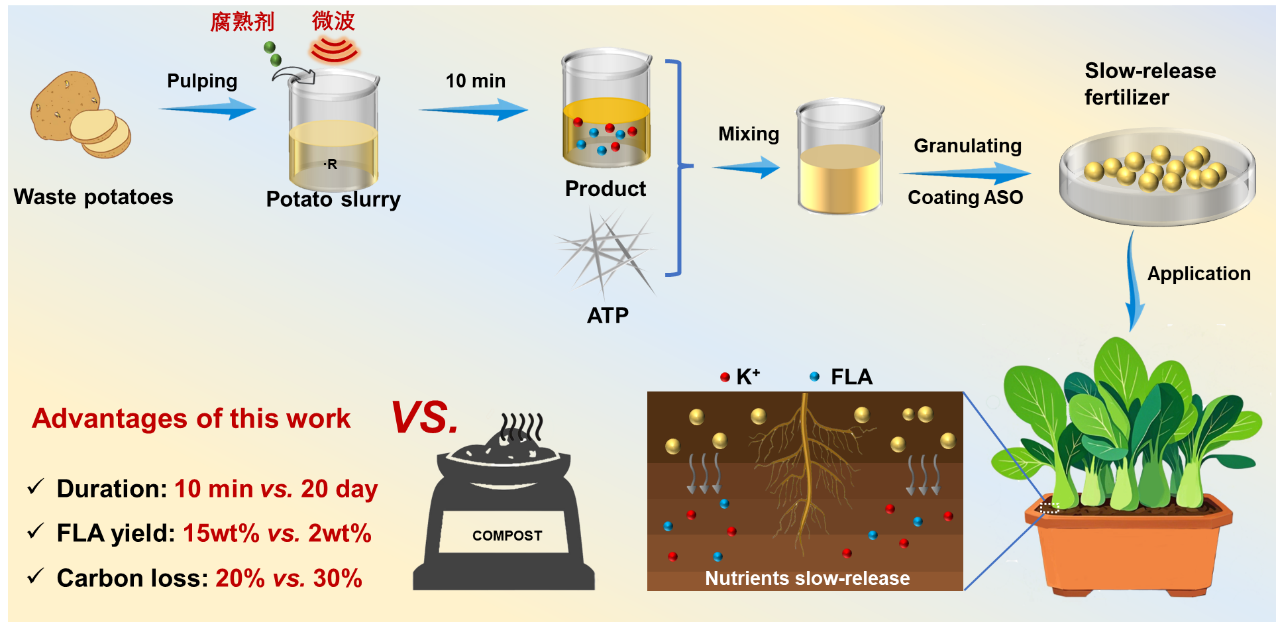
(the principle behind minute-level fertilization technology)
Building on the team’s original one-hour fertilization technology for organic solid waste (first-generation technology), they have developed a microwave-enhanced approach that achieves food waste fertilization within minutes. The key lies in using microwave irradiation to promote the generation of free radicals, which induce degradation–polymerization reactions of easily decomposable organic components such as polysaccharides and proteins in food waste. This process converts the waste into highly active fulvic acid-like substances within 10 minutes, which can be further processed into potassium fulvate-based nano-slow-release fertilizers. Importantly, compared to the first-generation technology, this process reduces the dosage of maturation agents by 75%, lowers costs by 50%, and increases efficiency by sixfold. Pot and field trials have demonstrated that the resulting fertilizer significantly promotes plant growth and root development while simultaneously improving soil microecology. Compared to traditional food waste composting, this technology offers advantages such as lower cost, higher fertilizer efficiency, and reduced carbon emissions, providing an effective new quality productive force for the efficient valorization of food waste into fertilizers.
This research was supported by the National Natural Science Foundation of China, Shanghai Agricultural Science and Technology Innovation Program, Shanghai Municipal Science and Technology Commission General Program Fund, Eastern Scholar Program, Taishan Industrial Leader Talent Program, Talent Revitalizing Inner Mongolia Program, the Proof-of-Concept Fund of Donghua University, and the Discipline Advancement Program of Donghua University.
To date, the rapid fertilization technology has been licensed to eight companies, leading to the construction of a production line with an annual capacity of 400,000 tons of rapid-maturation fertilizer. The technology has received multiple accolades, including the Outstanding Award at the National Disruptive Technology Innovation Competition, the Excellence Award at the Shanghai Gathering Talents Competition, the Benchmark Award and the Best Transaction Award at the Shanghai High-Value Patent Operation Competition(Top 3), as well as a Silver Award at the Challenge Cup. It was also selected as one of the Top Ten Cases for Youth Innovation and Entrepreneurship in Songjiang District, Shanghai in 2025. In addition, the team has elucidated the underlying mechanisms, with previous related findings published in Nature Communications (three articles).
(Original link to this article:https://doi.org/10.1038/s41467-026-68295-6)