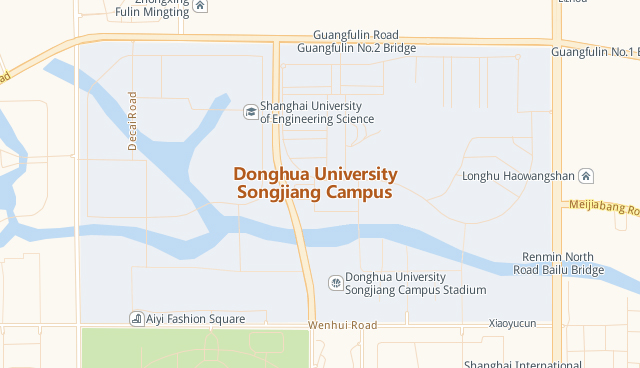
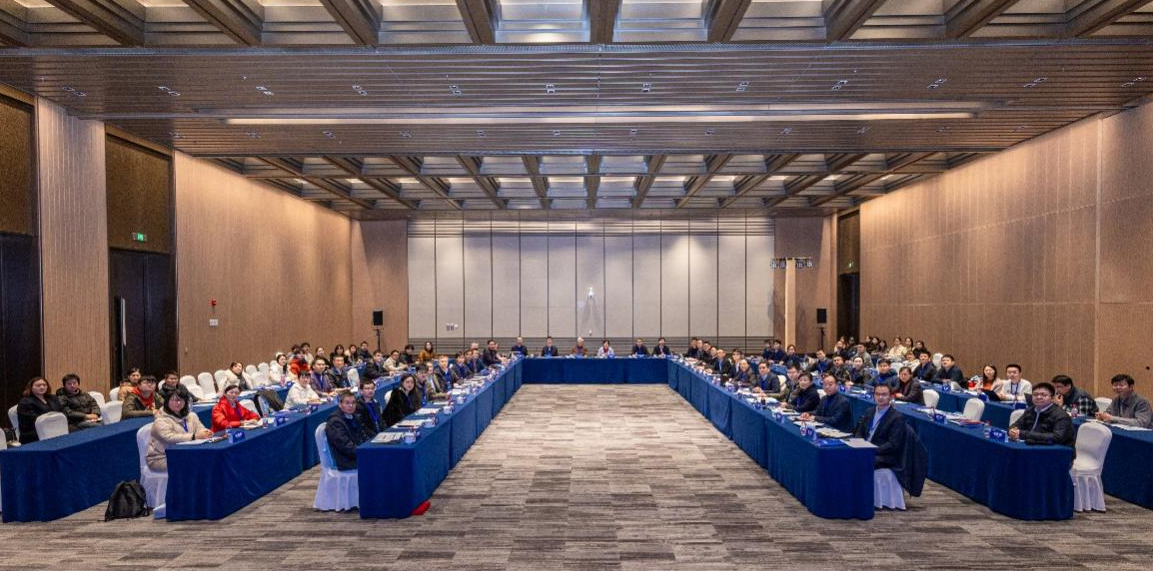
On January 28th, the Symposium on AI-Empowered High-Quality Development of Materials Science Education & Exchange Meeting on the Ministry of Education's "Materials-Empowered Education Large Model Project” opened in Nantong, Jiangsu Province. Donghua University Vice President Chen Ge attended the opening ceremony and delivered a speech.
The event was hosted by Donghua University and co-organized by 11 leading universities including Beijing University of Chemical Technology, Dalian University of Technology, Southeast University, Fudan University, Harbin Institute of Technology, East China University of Science and Technology, South China University of Technology, Tsinghua University, Sichuan University, Tongji University, and Southwest Jiaotong University, along with Chaoxing Group and China United Network Communications Group Co., Ltd. It was undertaken by institutions including the State Key Laboratory for Advanced Fiber Materials, bringing together academicians, experts, university representatives, and industry professionals from the fields of materials science and AI education to explore new pathways for integrating AI with materials education.
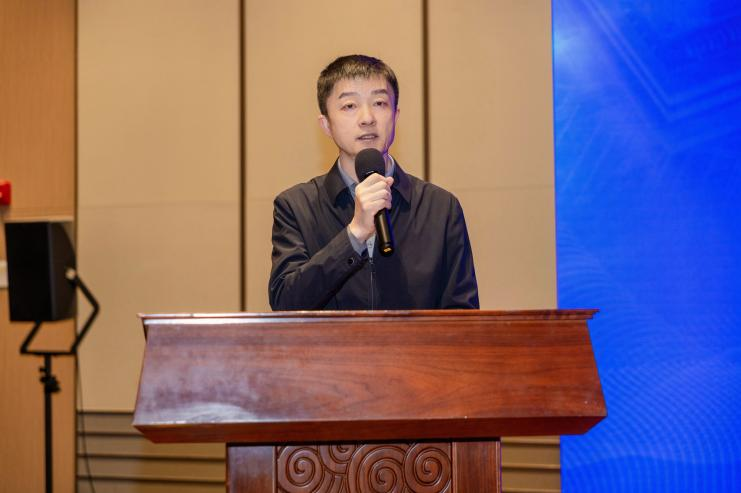
Chen Ge noted that materials serve as the cornerstone of industry and the vanguard of technological innovation, playing a pivotal role in national strategic development. The breakthrough advancements in artificial intelligence are reshaping the global industrial landscape. The Ministry of Education's deployment of the "AI+" initiative and the launch of the first batch of generative AI large model construction projects dedicated to education have charted a clear course for the deepening reform of higher education. Donghua University's leadership in the "Materials-Empowered Education Large Model: Building the Yangtze River Education Belt for Polymer Science with an ‘Axis and Two Wings’ Framework project” represents the Ministry's recognition of the university's strength in materials science and its innovative educational concepts. It also represents the mission entrusted to the university in this era. This symposium serves not only as a concentrated demonstration of the project's phased achievements but also as a crucial opportunity to build consensus, pool resources, and jointly explore pathways for development. It holds far-reaching strategic significance for advancing materials science education toward a more intelligent, systematic, and internationally oriented future.
Academician Yang Yuliang from Fudan University, in his interpretation of the “Tech Predictions and Future Vision 2049 Report” outlined a future blueprint for AI-empowered technological development, with particular emphasis on the prospects of AI's impact on education. Professor Wang Yujin from Harbin Institute of Technology shared insights on the current status, experiences, and future directions of engineering education accreditation in materials-related programs. Professor Ye Yicong from National University of Defense Technology introduced exploratory achievements in the integration of science and education empowered by AI from three distinct dimensions.
During the meeting, the project team reported on the phased progress of the "Materials-Empowered Education Large Model project”. As one of the first batch of generative AI large model construction projects dedicated to education launched by the Ministry of Education, the project has been led by Academician Zhu Meifang since its inception in October 2025, bringing together 11 partner universities and leading industry enterprises to form a research team of over 140 interdisciplinary talents. Focusing on the core challenges in talent cultivation within materials science, the project adopts a trinity framework of "fundamentals-problems-capabilities" as its core architecture. It has systematically constructed a disciplinary competency map covering core subject knowledge points, engineering practice scenarios, and multi-dimensional literacy requirements, while building a multimodal corpus encompassing classic textbooks, specialized books, and cutting-edge research papers. Preliminary development has been completed for functional modules supporting "five key areas” including student learning, teaching assistance, educational management, research support, and international collaboration, laying a solid foundation for in-depth development and scenario-based application of the large model. The meeting also witnessed the establishment of the "Materials-Empowered Education Large Model” Collaborative Innovation Alliance, marking the project's entry into a new phase of coordinated advancement and resource sharing. This reflects an integrated "industry-university-research-application" collaborative mechanism, creating a high-end platform for interdisciplinary exchange, technology sharing, and resource integration to support the high-quality development of materials science education.
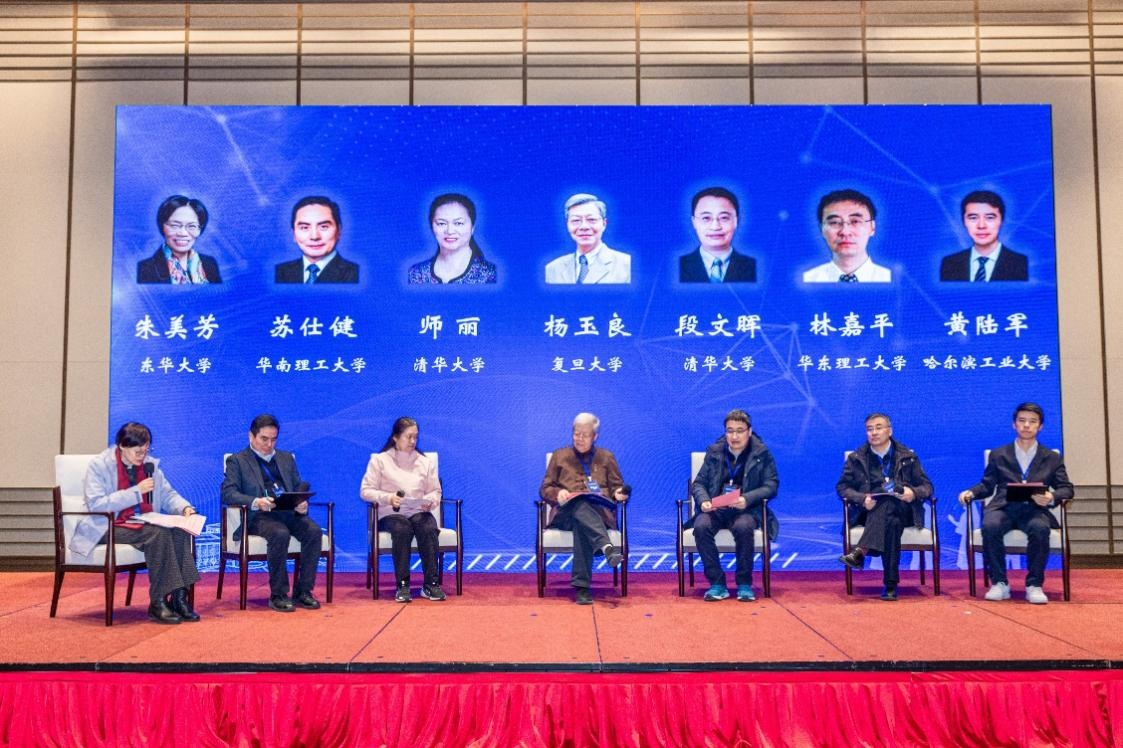
During the roundtable forum and discussions, participating experts engaged in in-depth deliberations on themes such as "AI+ Education" and "Development of Discipline-Specific Knowledge and Competency Mapping." They offered insights and suggestions to address critical challenges, including aligning talent cultivation with national strategies, leveraging research to enrich teaching, and integrating industry with education, thereby fostering broad consensus across multiple stakeholders.
This symposium responded to national strategies by promoting the deep integration of "AI and materials education," establishing a high-end platform for exchange and collaboration. It represents a significant initiative in implementing the digital education strategy and cultivating future-oriented technological talents, injecting new momentum into the organic connection between education, talent cultivation, industrial development, and innovation. The event marks a milestone in AI-empowered materials science education. Under the theme "AI∞Materials: Reshaping a New Paradigm for Disciplinary Education," the project focuses on core challenges in materials talent cultivation, adopting a trinity framework of "fundamentals-problems-capabilities." This signifies a substantive step forward for Chinese universities in the construction of specialized educational large models and the transition toward smart education within disciplines. Looking ahead, as the project advances and its scenario-based applications expand, it is expected to provide a replicable and scalable paradigm for materials science and emerging engineering education, further contributing to national technological self-reliance and industrial innovation and upgrading.