Recently, the research team led by Professor Yan Jianhua from the College of Textiles at Donghua University has made new progress in the study of visible-light degradation of organic pollutants. The related findings have been published in the international journal Advanced Materials (2025, e13684) under the title: “Constructing 0D Bismuth-Metal Nanosphere Networks on 1D/2D Bi2WO6 Heteromorphic Junctions for Efficient Photocatalytic Degradation of Acetaldehyde.”
With the rapid development of industrialization and urbanization, air pollution caused by volatile organic compounds (VOCs) has become increasingly severe, posing a serious threat to human health and the ecological environment. Semiconductor photocatalytic technology, which can directly decompose organic pollutants into harmless carbon dioxide and water under visible light such as sunlight, is regarded as a green, economical, and efficient environmental remediation strategy, demonstrating significant application potential. However, ideal photocatalytic materials must simultaneously meet multiple demanding requirements, including excellent visible light absorption, abundant and stable surface active sites, efficient photogenerated charge carrier separation and transport pathways, as well as high activity and stability even under low-concentration pollutant conditions. Achieving synergistic enhancement of these functional properties in a single material system has long remained a major challenge in material design.
Inspired by the segmented growth pattern of eucalyptus fruits along branches in nature, the research team proposed a spatially selective reduction strategy induced by heterostructures, successfully synthesizing a novel 0D/1D/2D Bi-BWO hierarchical photocatalyst. This approach led to the formation of a spatially ordered bismuth metal nanosphere network, establishing a dynamically evolving ‘metal-defect’ system that ultimately enhanced photocatalytic performance. The catalyst achieved complete degradation of acetaldehyde within one hour without any additives, exhibiting a degradation rate 3.5 times higher than that of unmodified 1D/2D BWO. Furthermore, it maintained stable performance over five consecutive cyclic tests, demonstrating excellent stability and promising application prospects.
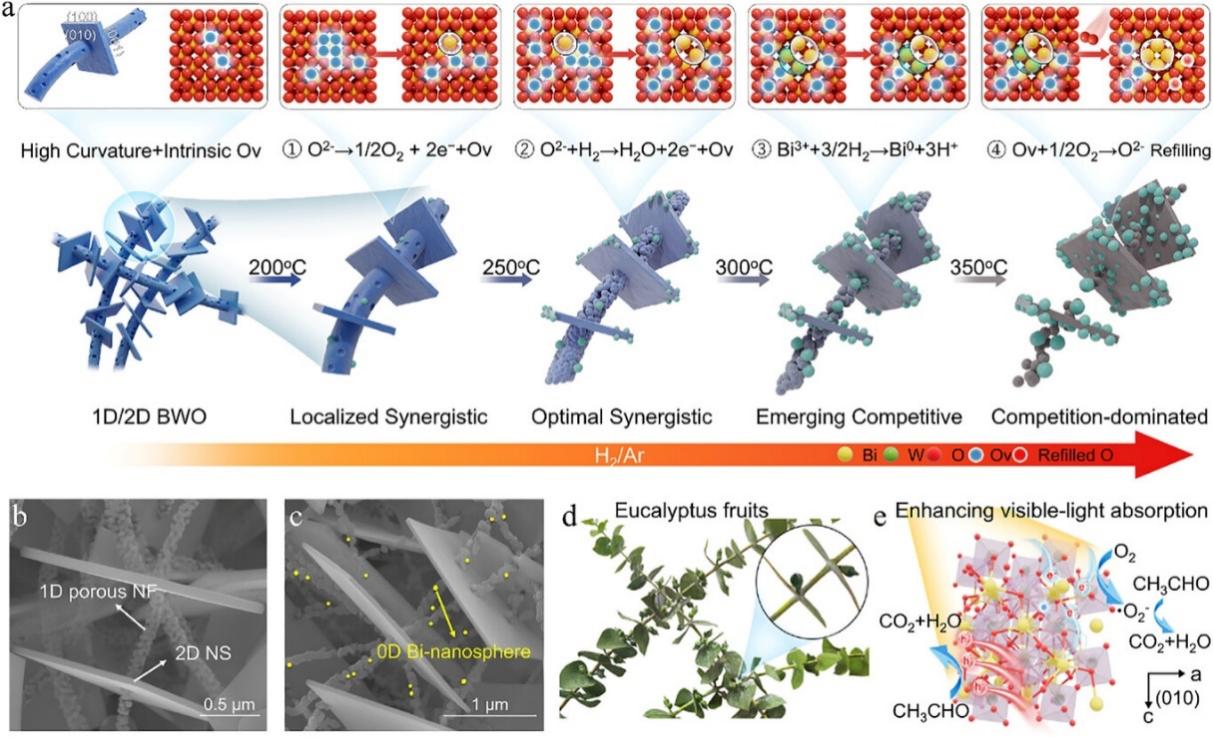
(synthesis and performance enhancement mechanism of 0D/1D/2D Bi-BWO hierarchical photocatalysts)
Professor Yan Jianhua's research team has long been dedicated to the design and application of functional materials. The current findings establish a novel biomimetic regulation paradigm of ‘structure induction - dynamic synergy - performance response,’ offering a viable pathway for the efficient design and mechanistic control of visible-light-driven photocatalysts.
Original link to the article:https://doi.org/10.1002/adma.202513684