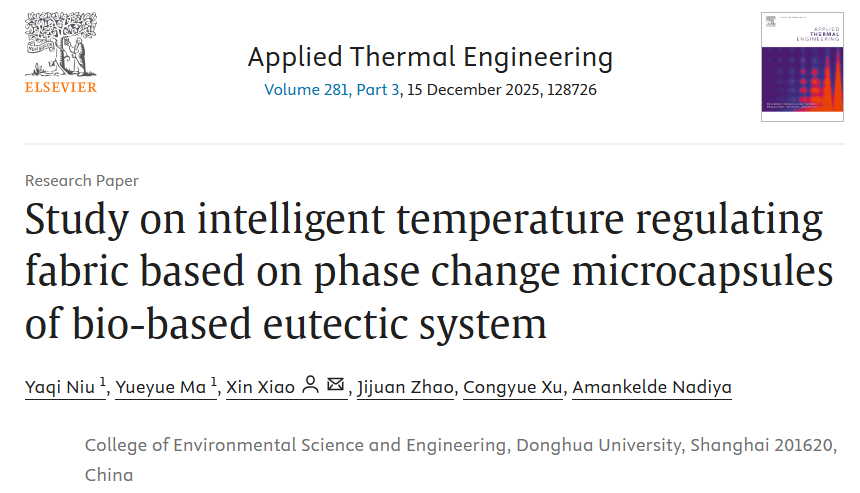
Recently, Professor Xiao Xin's team from the College of Environmental Science and Engineering at DHU has made progress in researching intelligent temperature-regulating fabrics based on phase-change microcapsules. The findings were published in the journal Applied Thermal Engineering (Q1 in thermodynamics, Q2 in its broader category) under the title “Study on intelligent temperature regulating fabric based on phase change microcapsules of bio-based eutectic system.”
To address the dual challenges of high energy consumption in the building sector and high carbon emissions in the traditional textile industry, this study innovatively develops an intelligent thermoregulatory fabric based on phase-change microcapsules. The research employs a eutectic system of lauric acid (LA) and myristic acid (MA) as the core material, prepares silica (SiO₂)-shelled phase-change microcapsules via the sol–gel method, and efficiently integrates the microcapsules with fabrics through dip–printing technology. The resulting intelligent thermoregulatory fabric effectively balances functionality, durability, and comfort while significantly enhancing both environmental sustainability and cost-effectiveness. It holds broad application potential in everyday apparel, aerospace suits, and special protective clothing, offering an innovative solution for building energy conservation and low-carbon transformation in the textile industry.
The key breakthroughs of this research include: replacing traditional petroleum-based core materials with bio-based alternatives and substituting toxic silicon sources (e.g., TEOS) with acidic silica sol, thereby achieving full-process greening of microcapsule preparation through an aqueous sol–gel route, which substantially reduces environmental impact; constructing a eutectic system to adjust the phase-change temperature of the microcapsules into a suitable range, with melting and crystallization onset temperatures of 36.63 °C and 32.50 °C, respectively, along with favorable latent heat values, overcoming the limitation of unsuitable phase-change temperatures of single fatty acids and better aligning with dynamic human thermal needs; replacing commonly used organic shell materials with hydrophobic inorganic shells, resulting in a mass loss of < 2.5% in thermogravimetric analysis (300 °C) and a leakage rate of < 0.01% in leakage testing (100 °C), significantly improving the mechanical properties, thermal stability, and leakage resistance of the microcapsules; the obtained phase-change microcapsules exhibit a uniform spherical core–shell structure with an average particle size of only 1.27 μm. Combined with an optimized dip–printing process, an intelligent thermoregulatory fabric with outstanding thermal regulation, comfort, and durability has been successfully produced, demonstrating a thermal hysteresis efficiency of 500% and a cooling efficiency of 105%.
Niu Yaqi and Ma Yueyue (both Class of 2022, Energy and Environment) are the co-first authors of the paper. Their fellow students Zhao Jijuan, Xu Congyue, and Nadiya • Amanka (also Class of 2022, Energy and Environment) are co-authors, with Associate Professor Xiao Xin serving as the corresponding author.
The research was supported by a National Undergraduate Training Program for Innovation and Entrepreneurship (NUTPIE) project, which has been successfully concluded with an Excellent rating. Material assistance was provided by Ms. Chen Qing from the International Fashion Center and the College of Fashion. The undergraduate team has an impressive award record, including a National Second Prize in the National University Student Social Practice and Science Contest on Energy Saving & Emission Reduction, a Special Prize in the Shanghai University Student Energy Saving & Emission Reduction Competition, and a Provincial Third Prize in the China National College Students Competition on Energy Economics (CNCEE).
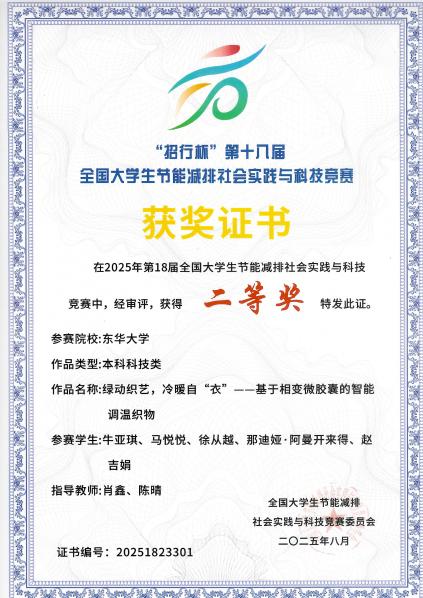
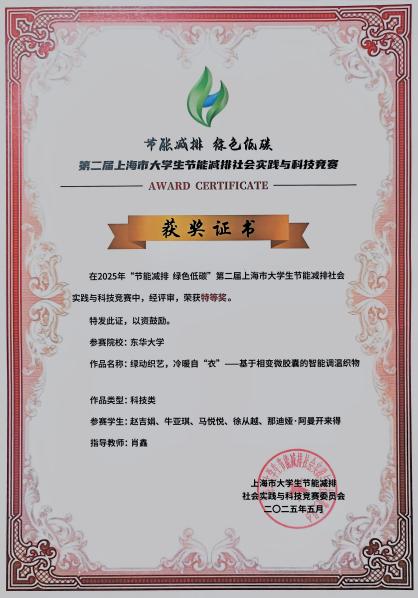
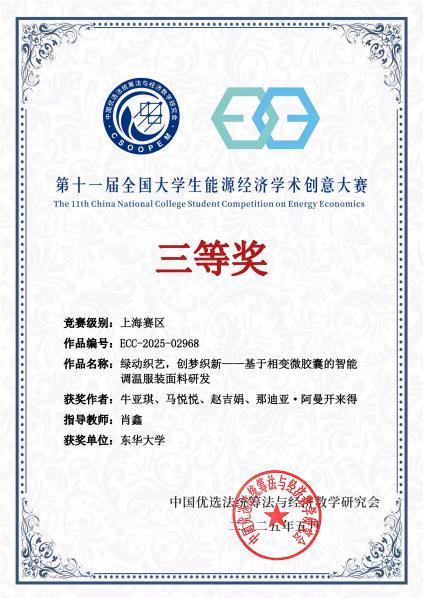
(Awards and Honors)
Original link to the article: https://doi.org/10.1016/j.applthermaleng.2025.128726