Under the guidance of the Center for Overseas Studies of the Ministry of Education, the International Education Center and the University Youth League Committee jointly organized the ‘Splendid Guizhou Journey — Sino-US University Student Intangible Cultural Heritage Research Program.’ This initiative aims to strengthen people-to-people exchanges between China and the United States, promote the global dissemination of outstanding traditional Chinese culture, and enhance the international influence of intangible cultural heritage. The program brought together 32 international students from 19 American universities, including the University of Massachusetts Amherst, University of Michigan, George Washington University, and American University, along with 5 members of the university’s Postgraduate Teaching Corps, for an immersive cultural research experience.
The project aims to cultivate cross-cultural understanding, design thinking, and intangible cultural heritage (ICH) preservation and innovation capabilities among Chinese and American university students, thereby advancing the living transmission and international dissemination of ICH. With support from the Guizhou Provincial Government Office in Shanghai, the project pioneered a cultural route focusing on Guizhou's intangible cultural heritage. Centered on the intangible cultural heritage of ethnic minorities such as the Buyi, Miao, Shui, and Dong peoples, the program conducted field studies in Zhenfeng County and Sandu Shui Autonomous County of Qianxinan Buyi, Miao Autonomous Prefecture, Leishan County in Qiandongnan Miao, Dong Autonomous Prefecture, Libo County in Qiannan Buyi, Miao Autonomous Prefecture, and Kaili City in Qiandongnan Miao and Dong Autonomous Prefecture.
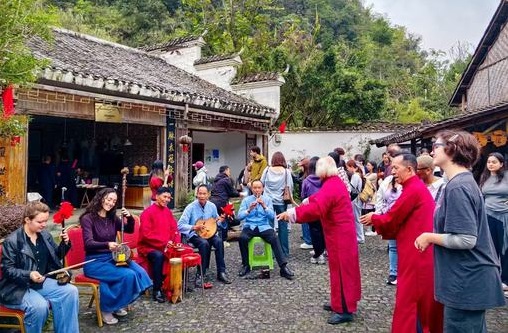
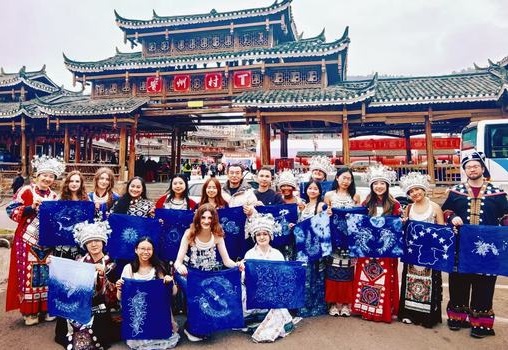
The research group visited the Huajiang Canyon Bridge, the world's tallest bridge, witnessing firsthand how infrastructure spans rivers and turns natural barriers into thoroughfares, while understanding the vital role of bridge-tourism integration in rural revitalization. In Buyi and Miao villages, they interacted with inheritors of intangible cultural heritage, experiencing the ‘Bayin Zuochang’ folk performance and traditional stick martial arts. In Sandu County, the team explored the Shui Ethnic Culture Museum, where historical exhibits provided deep insights into the migration history, agricultural civilization, writing system, and calendar of the Shui people. Exquisite Shui paper-cutting and horse-tail embroidery works drew widespread attention. In Kaili City, students learned batik techniques at a heritage workshop, creating cultural and creative products, and even wore traditional costumes to join locals on the ‘Village Runway,’ interpreting the charm of ethnic clothing through a cultural fashion show. Beyond cultural exchanges, the stunning landscapes of the Beipan River Canyon, the unique karst formations of Libo's Small Seven Arch Bridge, and the distinctive ethnic ambiance of Qianhu Miao Village left a lasting impression on all participants.
Sydney Mager, an exchange student from the University of Massachusetts Amherst and a current undergraduate at our university, remarked: “Learning about other nations' cultures through their clothing left a deep impression on me. I am truly captivated by China's rich and diverse ethnic cultures.” Ma Yutong, a member of our university's graduate volunteer teaching group, shared: "My journey through the mountainous landscapes of Guizhou, exploring intangible cultural heritage and ethnic traditions with international friends, has allowed me to deeply appreciate the charm of cultural exchanges between China and other countries, while laying a cultural foundation for my volunteer teaching endeavors." Foreign instructor Lin Jubie noted that the thematic study camp provided a cross-cultural platform for diverse ethnic groups. Participants engaged face-to-face with locals, experiencing intangible heritage firsthand while learning traditional skills and gaining insights into their daily lives.
According to reports, in order to advance the construction of an education powerhouse and high-level opening up in education, comprehensively enhance the quality and connotation of ‘Study in China,’ and promote the high-quality and sustainable development of study tour programs, the Service Center for Overseas Education of the Ministry of Education has launched the ‘Study Tour in China’ curriculum system. Our university's International Education Center, Youth League Committee, the Guizhou Provincial Government's Shanghai Office, and practical study bases have closely collaborated, reaching multiple university-local cooperation intentions. We will continue exploring the international dissemination of Guizhou's intangible cultural heritage, the contemporary interpretation and innovation of ethnic intangible cultural heritage elements, and jointly tell authentic, multidimensional, and comprehensive stories about China. This activity has been tracked and reported by media convergence centers across Guizhou.