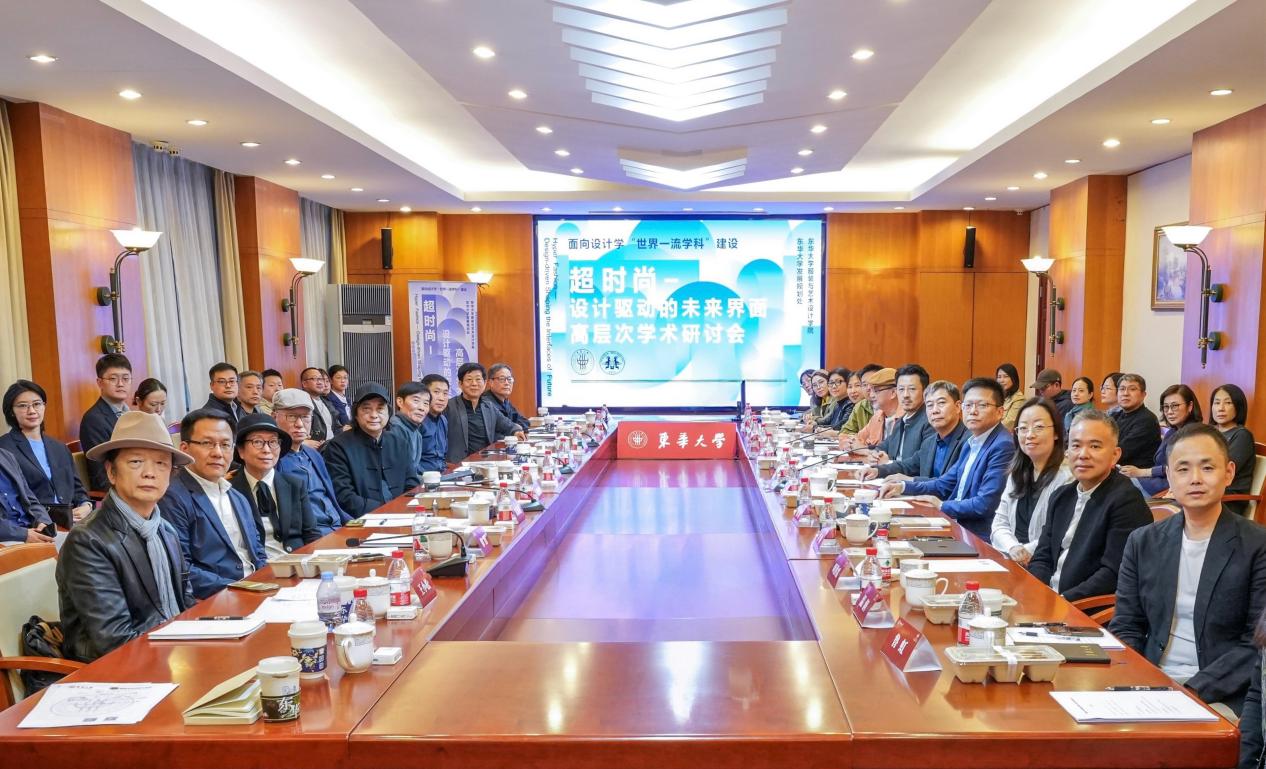
Recently, the high-level academic forum "Hyper-Fashion: The Future Interface Driven by Design" was held at Yan'an Road Campus, jointly organized by the College of Fashion and Design and the Development Planning Division of our university. The forum gathered renowned design education experts including Ning Gang, Zhan Heping, Fan Shengxi, Yang Dongjiang, Wu Haiyan, Wang Min, Han Ting, Fan Kaixi, and Wang Xiaosong, who provided insights and recommendations for accelerating the cultivation of DHU's world-class design discipline. Vice President Zhang Qinghua attended the meeting and delivered concluding remarks.
Zhang Qinghua expressed gratitude to the participating experts for their strategic guidance in his address. He emphasized that the design discipline must closely align with national and regional industrial strategic needs, proactively integrate into the university’s overall disciplinary development layout, refine its own positioning, clarify its developmental mission, and optimize its construction path. The university will benchmark against the new round of the ‘Double First-Class’ initiative, research and introduce relevant policy measures, and strengthen the evaluation orientation of ‘emphasizing service and strong contribution’ to accelerate the creation of new disciplinary peaks. He urged the college level to enhance the execution of planning, focus on specific ‘nerve-ending’ tasks, and start from the details to ensure that the strategic blueprint is translated into solid actions.
Sun Jie, Dean of the College of Fashion and Design, presided over the meeting and delivered a thematic report, systematically introducing the college’s historical evolution, recent developments, and the construction ideas and development pathways for the design discipline during the ‘15th Five-Year Plan’ period.
It was reported that the design discipline of the college recently achieved 7th place nationally in the 2025 Soft Science Ranking of Best Chinese Disciplines, marking its first entry into the top 10. In particular, the talent cultivation indicator was rated 1st in the country. Moving forward, the design discipline will focus on sustainable fashion design oriented toward the transformation of intelligent industries and future social life, striving to cultivate innovative design leaders with ‘global fashion competence.’ The aim is to establish a DHU paradigm for first-class design education, with ‘Hyper-Fashion’ as the core concept, driven by the three pillars of ‘sustainable fashion,’ ‘design-driven innovation,’ and ‘intelligent technology,’ thereby achieving deep interdisciplinary integration across design studies, art studies, engineering, computer science, and business.
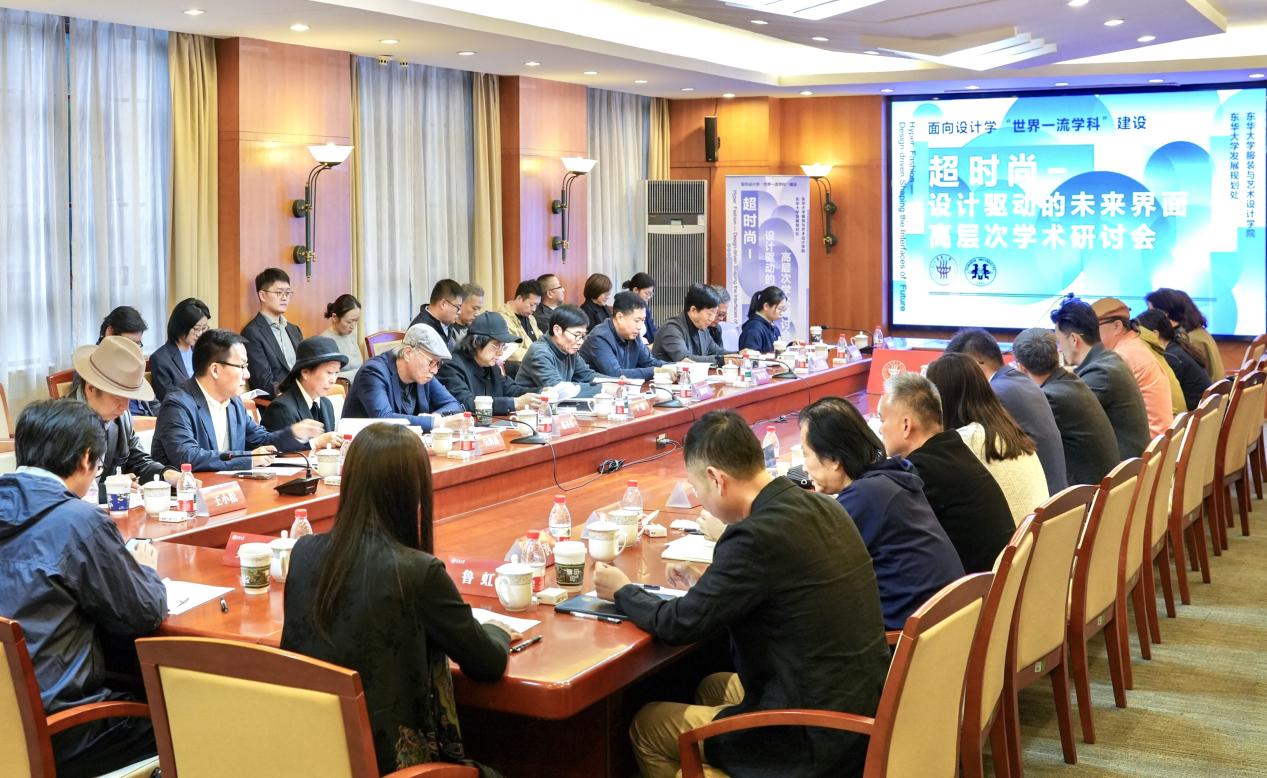
The participating experts engaged in in-depth and productive discussions centered on the theme "Hyper-Fashion: The Future Interface Driven by Design," offering numerous forward-looking strategic recommendations for the future development and practical pathways of Donghua University's design discipline. The experts fully acknowledged the visionary nature of the ‘Hyper-Fashion’ concept, which reinterprets the profound connotations of fashion within the context of interdisciplinary design, serving as a ‘super interface’ connecting the physical and virtual realms and demonstrating significant potential. Leveraging Donghua University's geographical advantage in Shanghai and its unique resources in ‘integrating art and engineering,’ the design discipline should adhere to the trinity of ‘Hyper-Fashion—High Intelligence—Strong Culture,’ deeply explore expansion into cutting-edge fields such as digitalization and intelligence, and strive to build a fashion-oriented design discipline ecosystem and an urban design education paradigm. This effort aims to contribute significantly to supporting Shanghai’s ‘World Design Capital’ initiative, serving regional economic and social development, and leading contemporary fashion trends.
Regarding the development of interdisciplinary design, the experts recommended establishing practical and effective discipline management mechanisms. This can be achieved through cross-disciplinary curricula, joint research projects, and other diversified approaches to foster deep integration of professional resources and collaborative innovation across disciplines. It is essential to further integrate internal resources and optimize synergy with the university’s broader disciplinary ecosystem, while actively participating in the national development and construction of design disciplines. Additionally, the university should support the college in establishing outcome evaluation standards and faculty selection mechanisms that align with its disciplinary development needs and professional characteristics. Deepening industry-academia collaboration is also critical to ensure interdisciplinary design truly serves social innovation and industrial upgrading. Exploring the establishment of a ‘Design Fund’ and driving educational optimization and reform through the integration of industry, academia, and research were also highlighted as key recommendations.
At the meeting, the Qingta Higher Education Research Department was invited to deliver a special report titled "Comparative Analysis of the Development of Design Studies at Donghua University and Strategies for Achieving First-Class Status." Combining insights with the policy direction of the new round of the ‘Double First-Class’ initiative, the report provided opinions and suggestions on accelerating the cultivation of design studies as a first-class discipline. The meeting was attended by over 70 participants, including heads of departments and institutions such as the Development Planning Office, the College of Fashion and Design, the Shanghai International College of Fashion and Innovation, and the Shanghai Textile and Costume Museum, along with representative professors, teachers from the Discipline Development Center, and mid-career and young academic faculty members.
It is reported that the university is further advancing the optimization of its disciplinary structure, with a focus on three major directions: ‘Textiles + Fashion,’ ‘Materials + Energy,’ and ‘Intelligence + Health.’ The aim is to build disciplinary clusters and establish a new model for developing three distinctive and advantageous disciplines, while fostering and expanding five strategic emerging disciplines. These efforts will radiate influence to promote the flourishing development of foundational disciplines and humanities and social sciences, gradually forming an disciplinary ecosystem aligned with the construction of a high-level research-oriented university. In the future, the university will focus on deepening interdisciplinary integration, consolidating resources and strengths, and strengthening organized research to build a new model for ‘Greater Design’ discipline development and accelerate the cultivation of Design Studies as a first-class discipline.